Is it possible to retire early in Bolivia on $887 Month?

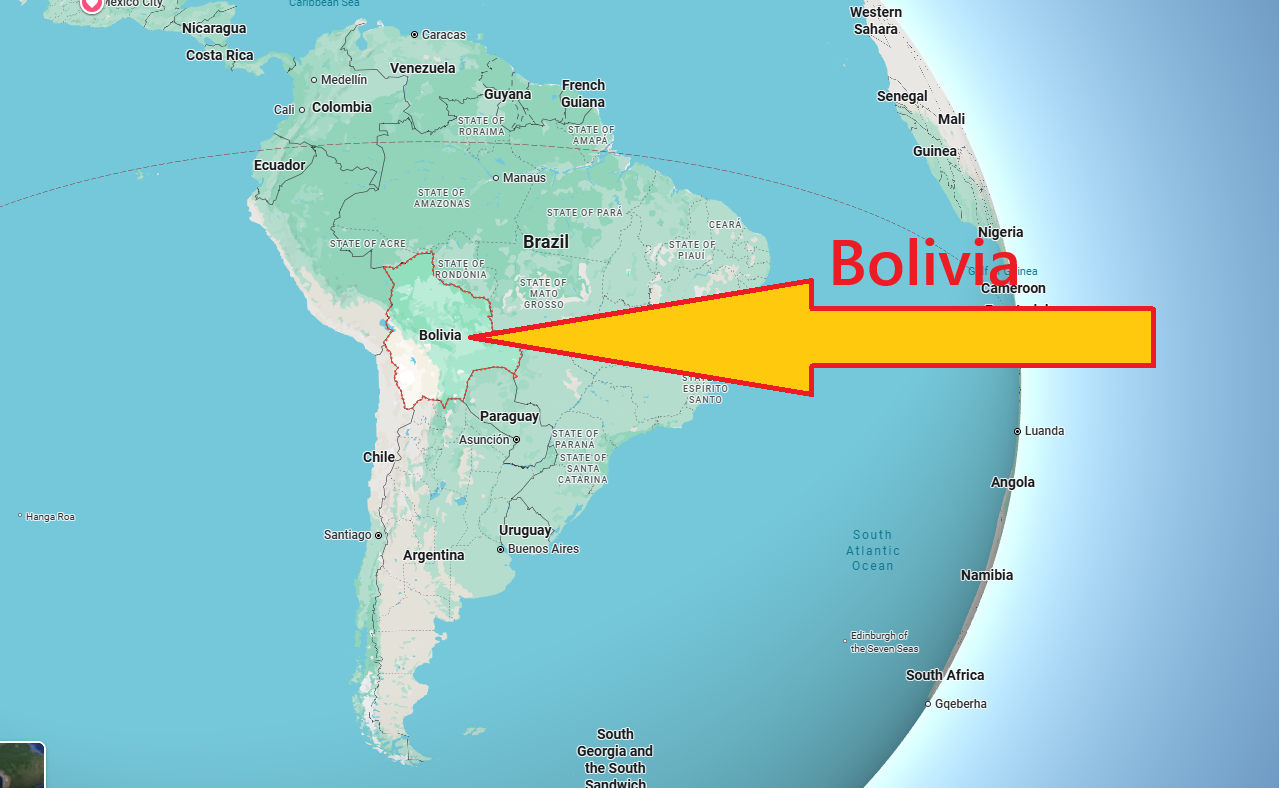
With my feet on the ground, I am going to show you living cost estimates for the low to middle range, and why some people are retiring in La Paz, Bolivia, the capital.

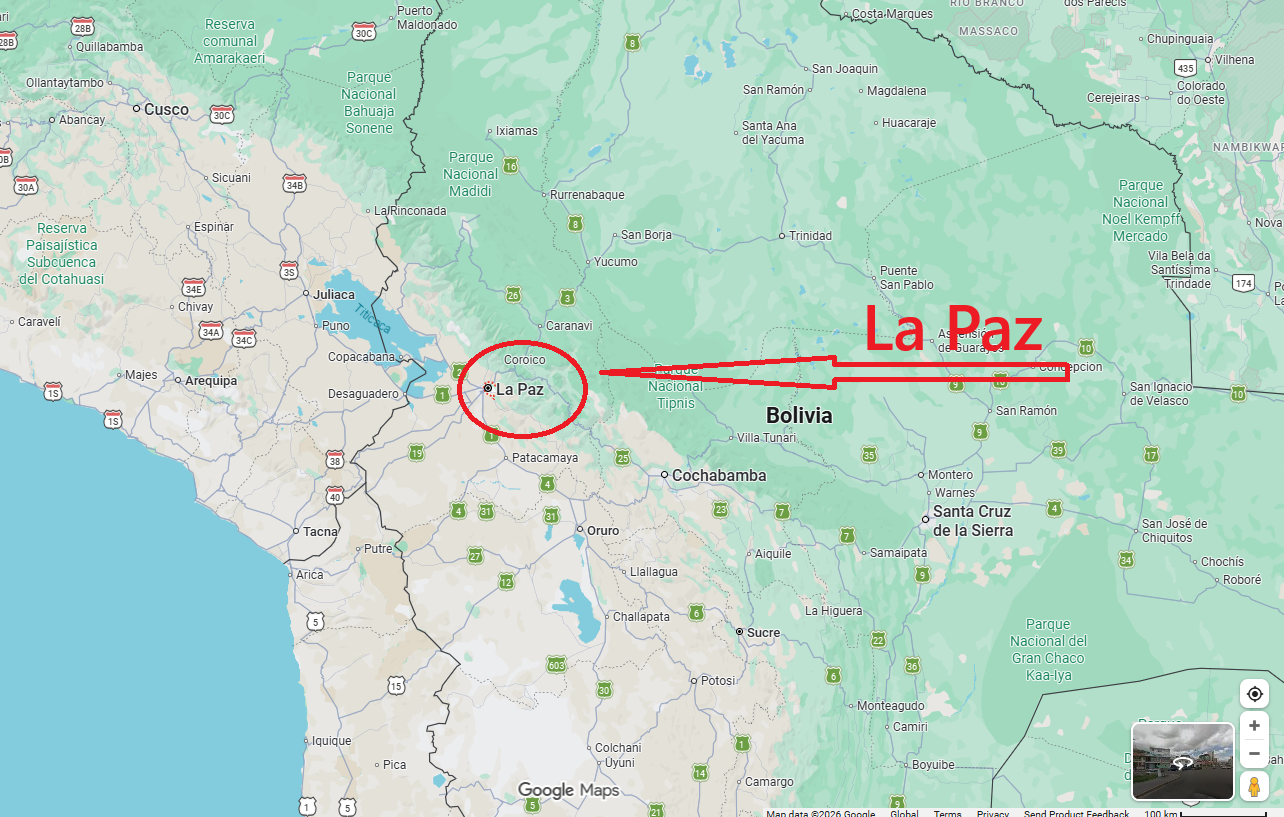
First, I will show you around La Paz, Chile, in the above video, so you know whether or not you are even interested in living or retiring here. Second, I will share low to middle-range living costs. Third, I will share visas, residency, healthcare, walkability, weather, social considerations, things to do, and safety.
This was my first time in Bolivia, making it my 77th country. I left the USA 19 years ago, and I travel the world, and show you the best places to retire affordably overseas. So subscribe to learn about my favorite countries for affordable overseas retirement.
The beautiful woman you see in the videos with me is Qiang of the Hobo Ventures YouTube channel. Subscribe to Qiang’s channel if you want to see our daily lives as we move forward, slowly traveling the world on one-way tickets.
Altitude Sickness
La Paz is at such a high elevation that some people get altitude sickness when they first visit. I was fine, but Qiang was nauseated and passed out about an Hour after we landed in La Paz. Most people feel fine after 2 or 3 days, but contact this doctor if necessary. Dr. Espada Lozada Andrés.
He gave Qiang an IV drip that had her up and walking around in just a few hours. Dr. Andres came to our accommodations and took care of Qiang. At the time of our visit, for the treatment Qiang needed, the home visit with medicine cost 450 bs ($70 USD). He was referred to us by our Airbnb host (below)
La Paz Old Town Walking Tour
Here is a map of my favorite areas in La Paz, Bolivia. This walk would take a few hours, but we show you many of the highlights in the above video.

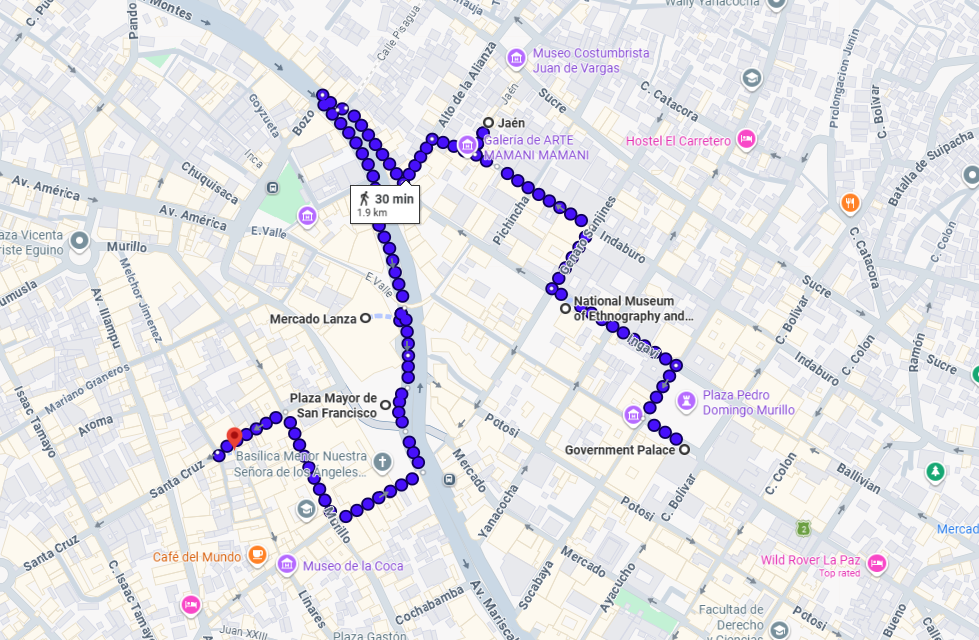
Here is a brief description of each stop on the old-town walking tour of La Paz.
Plaza Murillo, designed in 1558, is the political center of Bolivia, where both executive and legislative powers. The Plaza is named after Pedro Domingo Murillo, who started the independence movement in 1809. His last words before being hanged in this plaza were, “The torch that I have lit, no one will be able to extinguish.” He evangelized independence from Spain. Presidential Palace (pink and white), Legislative Palace (clock dome), and Metropolitan Cathedral.
National Museum of Ethnography (MUST SEE MASK ROOM) is housed in an early 18th-century colonial palace. It is a cultural institution displaying the “living cultures” of the country’s diverse ethnic groups. It includes masks still worn today in traditional festivals like the Carnival of Oruro, representing spirits, animals, and historical figures.
Calle Jaén is widely considered the best-preserved colonial street in La Paz. The street includes the home of Pedro Domingo Murillo, the leader of the independence movement, where secret meetings were planned to achieve independence from Spain.
Mercado Lanza is a multi-level “gastronomic heart” of La Paz. Located next to the San Francisco Church, where thousands eat daily. The upper floors are famous for affordable, authentic “paceño” (La Paz style) comfort food.
Plaza Mayor de San Francisco is known as “Plaza of the People,” and starting ground for almost every major protest and revolution in Bolivian history. Up to 100,000 people gather for political rallies, concerts, and festivals here. Excavations here have uncovered ceramics suggesting this was a sacred place before the Spanish arrived.
The plaza includes the Basilica of San Francisco (1743), which demonstrates how Rome blended Catholicism with indigenous symbolism of tropical fruits, birds, and masked figures to convert the original people throughout Latin America.
The Witches Market (Mercado de las Brujas) is where the original Aymara spiritualism survives in La Paz. Aymara spiritual healers, or Yatiris, wear their traditional black hats and coca leaf pouches. Yatiris read coca leaves to predict the future and perform blessing rituals. The “Mesa” Ritual burns a colorful bundle of sugar tablets, herbs, incense, and a llama fetus to “feed” the Earth goddess.
Cable Car Tour (Round trip starting from Sopocachi Station)
Start at Sopocachi Station (Yellow Line / Línea Amarilla): Head up the mountain to see amazing views of La Paz and the surrounding mountains.
Transfer to Silver Line (Línea Plateada): When you reach the top, transfer to the Silver Line. The views on the Silver line as you hang over the city are the best views in Bolivia.
Transfer to Red Line (Línea Roja): When the Silver Line drops you, head back down into the city on the Red Line. You will see the colorful Chualluma neighborhood and the General Cemetery.
From the Central Station (where the Red Line drops you) take the White line to return to the Sopocachi area.
Cochabamba, Bolivia
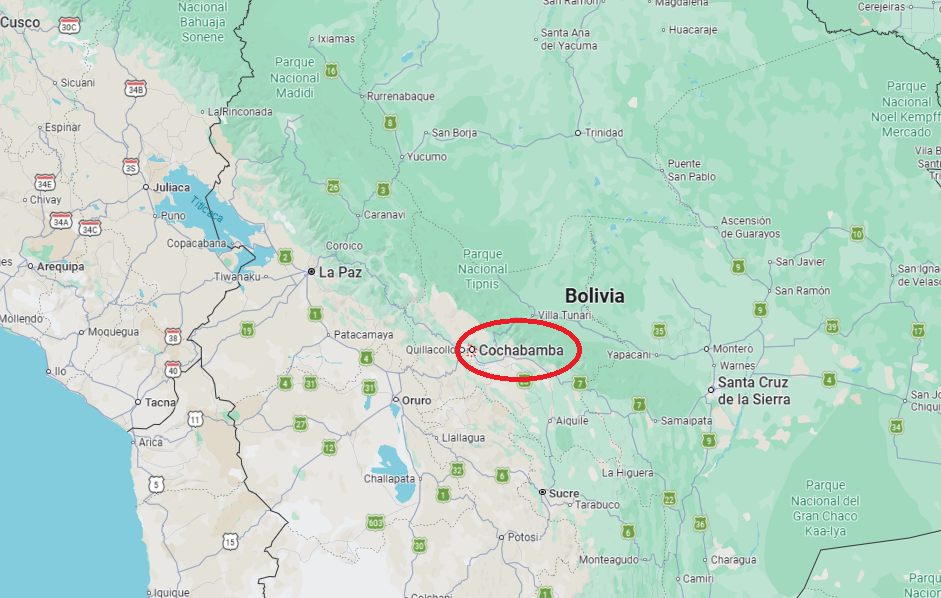

While in La Paz, Bolivia, we met a man from the UK who had lived in Bolivia for over a decade. We asked him what his favorite city in Bolivia was. He asked us if we had been to Cuenca, Ecuador. We explained that we loved Cuenca, Ecuador.
He said that if we loved Cuenca, Ecuador, we would love his favorite city in Bolivia, called Cochabamba. Sadly, we had already booked a non-refundable flight leaving Bolivia the next day, so we didn’t have time to visit Cochabamba. So make sure to spend time in both La Paz and Cochabamba, Bolivia, before deciding where to retire here.
He said that Cochabamba was cheaper than La Paz and was at a lower altitude. So the weather is actually warmer than La Paz, but never too hot or too cold. So make sure to include Cochabamba on your exploratory visit to Bolivia.
Cochabamba, Bolivia, and Cuenca, Ecuador, are remarkably similar in elevation, both situated within the Andes mountains at approximately 2,550 to 2,600 meters, and both offering temperate climates.
Estimated Cost to Retire in La Paz, Bolivia
Now, I will give a line-item estimate of the cost of living for two people. Then I will share information about retirement visas, healthcare, walkability, weather, social considerations, things to do, and safety.
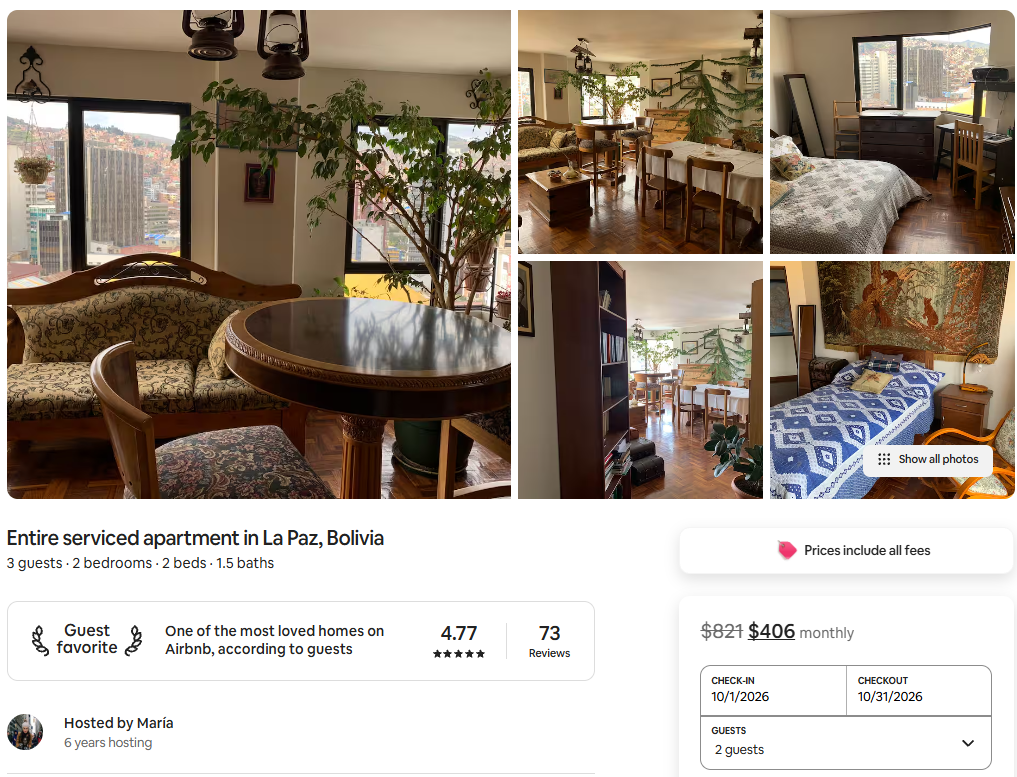

Rents: I found the above 2-bedroom furnished apartment for rent in a nice area of La Paz, Bolivia. It is advertised today for $406 USD for one month on Airbnb, including utilities. If you rent it for a day or a week, it would be much more expensive.
We saw one-bedroom apartments ranging from $200 to $400 per month, unfurnished. If you moved here year-round, you would have to pay your own utilities and furniture.
So, for the lower-cost-of-living estimate below, we estimate about $275 per month for a one-bedroom apartment, year-round. If you rent a larger apartment long-term, the rent would be higher, starting around $600 USD per month or more, depending on the area and size.
Here is the process we use to find great apartments.
Utilities: We estimate the year-round average for utilities for the smaller apartment above would be about $40.00 USD per month. The utilities would cost more for the larger space, starting at around $80 USD per month.
Groceries: We estimate about $310 per month for the two of us. Other expats are likely to purchase more imported foods from their home country, spending $475 per month on groceries.
Restaurants: We would eat out twice per week at local-style restaurants, ranging from about $4 to $6.00 USD per meal per person, and one or two splurges per month at $8 to $14 USD per meal per person. If you add it all up, we would spend around $128 per month on restaurants for the two of us. We may have a beer here and there, but that is covered below in alcohol.
Other expats are likely to eat more often at expensive restaurants and very little, if any, in local-style restaurants, so they would likely spend more like $264 per month for 2 people in restaurants. It is lifestyle-dependent.
Cell Phone Data: The cost to get a prepaid SIM card with 20 GB of data for your unlocked smartphone is about $40 USD per month.
Other expat couples are likely to buy two prepaid SIM cards, so they would spend $80 USD per month or more if they switch to postpaid service.
Laundry: Unfurnished apartments in Chile rarely come with clothes-washing machines. You can buy a new washing machine for about $275 USD, and the laundry detergent is included in the groceries bill.
Drinking Water: We bought RO drinking water from the grocery store. But if we retired here, we would buy a RO water filtration unit. Decent units start for around $350 USD. The replacement filters are around $120 per year, so we estimate about $10 per month after we purchase the unit.
Internet: 60 Mbps in-home wifi is about $30 USD per month.
Transportation: All of our daily needs, including groceries, shopping, restaurants, coffee shops, and nightlife, would be within a 20-minute walk.
We may take an Uber home at night or to the grocery store twice a week, averaging about $2-4 USD per ride or $28 per month. We would also take public transportation (buses/trains/gondolas) a few times per month to explore other parts of the city. So we would spend about $54.00 per month on transportation.
Other retirees may want to pay cash for a used car, but would still need to pay another $250 per month or more for gasoline, repairs, and insurance.
Alcohol (Optional): Half a liter of domestic beer is about $2 USD in grocery stores. In bars and restaurants, domestic beers are around $3-$5 USD. So, we estimate about $120 per month for the two of us.
Many other expats would spend more on imported, craft, or foreign beers in convenience stores, bars, and restaurants, so we estimate about $230 USD per month for 2 people, assuming they do not drink imported whiskey or wine.
Entertainment (Optional): We would budget about $200 per month for the two of us. We generally enjoy doing more do-it-yourself kinds of entertainment, so other expats would spend a little more, maybe $300 per month, for 2 of them.
Basic Costs to Retire in La Paz, Bolivia
After the cost-of-living section, I will share information on visas, residency, real estate, walkability, healthcare, and safety. The first link in the first comment below this video provides details on how I arrived at each line-item cost.
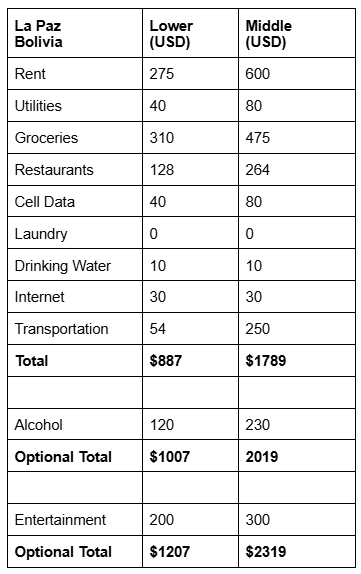
We gathered this data on the ground here in February of 2026, so adjust for inflation after that. The above lower cost-of-living estimate would apply if the two of us lived here on a tight budget. The middle estimate is just an example of what more typical expat couples might spend if they moved here.
So, what would it cost you to live in La Paz, Bolivia?
To understand what it would cost you to live here, you must put your feet on the ground, see how you would choose to live, eat, and entertain yourself, and add it all up. It doesn’t matter what anyone else spends because we are all different.
You should also add anything to the above table that you spend money on in your home country that is not listed in the above table. Presumably, you find those things necessary in life. To do that, visit the Numbeo La Paz and add anything not mentioned in the above table. Anything not on Numbeo you should add during your exploratory visit before moving to Santiago.
Never move anywhere until you have visited first personally to verify the living costs for your lifestyle and needs. I am not guaranteeing these prices. These are just my notes and estimates from the time of my visit and this post. Your costs will likely be drastically different depending on your lifestyle and the time since this post was published.
Typical expats’ living costs in Chile range from about $700 to $3,000 per month, depending on their lifestyle, budget, and whether they live in a city or a rural area.
La Paz, Bolivia, Livability Factors
Before you move anywhere outside your home country, make a list of the factors you must have for a happy retirement. Here are my livability factors, and I will rank each as high, medium, or low before assigning an overall retirement desirability score for La Paz, Bolivia.
Walkability: High. We stayed in the middle of our favorite part of La Paz, called Sopocachi. Sopocachi has a great nightlife, restaurants, coffee shops, live music, and shopping. In that general area, everything would be so centralized that we would rarely need to walk more than 20 minutes to get what we needed for everyday life. Plus, walking is the healthiest way to stay in shape as we age.
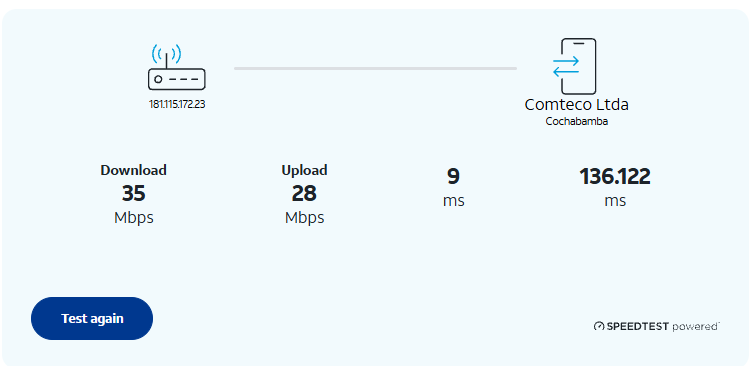
Internet: High. The in-home Wi-Fi in our apartment was 28 Mbps up and 35 Mbps down. Good enough for Zoom calls, uploading YouTube videos, and watching Netflix. We were also able to use our cell phones as hotspots when we were out of the house together.
 Food: High. We found some great restaurants in La Paz, as shown in our restaurant list below. We would eat out a few times a week, mostly at local-style restaurants, but would cook more meals at home. We would also splurge a few times per month at expensive restaurants.
Weather: Medium. Bolivia lies south of the equator, so summer runs from November through March. The Sopocachi area of La Paz is at about 3,650 meters (12,000 feet) above sea level. Summer daytime highs in La Paz range from 67 °F (19 °C) in November to winter daytime highs of 62 °F (17 °C) in July, with very little seasonal variation in daytime highs. Nightly summer lows average from 44 °F (7 °C) in November down to 30 °F (-1 °C) for winter average nightly lows in July. The rainy season is in the Summer, from November to March, with January typically being the wettest month with about 172 mm 80–123 mm (6.78 inches).
Things to Do: Medium. La Paz is the capital of Bolivia and has the highest elevation of any capital city in the world at about 12,000 feet (4000 meters). The metro area has about 2 million people living there, with about 755,000 living within La Paz proper.
La Paz has an aerial cable car system for public transportation with the most spectacular views of the city. Locals enjoy socializing over meals, exploring the local markets for bargains and snacks, and enjoying lively music both traditional and modern, and dancing in the bars and restaurants.
La Paz has a deep-rooted tradition of theater, classical music, and other high-culture entertainment, much of which is centered in the historic downtown and the bohemian Sopocachi neighborhood.
Soccer (football) is immensely popular in Bolivia. The Football here is played at an extreme high altitude, and the Hernando Siles Stadium is located at 3,582 meters (11,752 ft) above sea level, creating a unique physical challenge for visiting teams, and a legendary venue in South American football.
Tourists in La Paz primarily enjoy high-altitude adventures such as adrenaline-pumping mountain biking, day tours of the Witches Market to see traditional magic like dried llama fetuses, spells, and medicinal herbs. Our favorite was the Cholita Wrestling, watching indigenous women in traditional dress compete in high-energy wrestling matches.
We also enjoyed the “almost free” (tips only) walking tours that cover Plaza Murillo, the Basilica of San Francisco (where you can climb to the roof), and the colonial Calle Jaén.
Bolivia’s Carnaval Paceño: Come to Bolivia in February or March to witness Bolivia’s Carnaval Paceño. It is the most anticipated festival of the year, held annually in the days leading up to Ash Wednesday. Watch YouTube videos about it online. It will blow your mind.
Social Considerations: Medium. English is not widely spoken in Bolivia. If you intend to retire here, you should learn Spanish for a fuller life. I have met many expats overseas who have used Duolingo, the free language-learning smartphone app, to learn various languages. If you are just visiting, become familiar with using Google Translate on your smartphone before you arrive. This worked out fine for us on our exploratory visit.
Safety: Medium. If we retired here, we would live in the central area of La Paz, such as around the Sopocachi neighborhood. We walked all around there in the evenings, and it felt safe to us.
However, we would use Uber taxi to get home at night if we started to feel isolated while walking. Also, the US State Department issues travel advisories for each part of the world, which you should be aware of. Read that before you go, and thereafter from time to time to stay up to date. Bolivia, at the time of this writing, is “Level 2: Use Increased Caution.” Here are my thoughts on how to remain safe all over the world.
Expat Community: Medium. Here are some Facebook groups 1, 2, 3, 4, and 5 that cater to English-speaking expats living in La Paz and the surrounding areas. These online expat communities are great for learning what expats want to know when they first move overseas. You will often find that someone has recently answered your questions, so first search for already answered questions before asking in these groups.
Medical: Low. This healthcare international comparison index ranks Bolivia poorly compared to most countries in the world. However, Chile and Colombia rank in the top 100 in the world, 51st and 36th, respectively, both ranking better than the United States, which ranks 69th. There are different ways healthcare is rated, but this one seems to be considering not only the quality of care but also what patients are charged.
Retired permanent or temporary residents of Bolivia can enroll in SUS to provide basic medical coverage to residents, including foreigners, by presenting their foreign resident ID card and proof of address. SUS is designed to provide primary care such as general medical and dental consultations, vaccinations, and preventive services at local health centers. Hospital care includes surgeries and physical therapy, and other care includes cancer and CT.
Expats using SUS often complain of long wait times and shortages of basic medications. Public hospitals in major cities are typically better equipped than in rural areas.
Many retiree expats opt for private physicians and clinics for specialized care due to the low out-of-pocket costs compared to Western countries, often $15 to $30 per visit. Some expats maintain private or international health insurance to ensure faster access and English-speaking staff.
Tourist Visa: High. For most tourists from Western countries, the recommended option is a visa-free entry. The rules change often, but at the time of this writing, visa-free entry allows up to 90 days per calendar year for citizens of the UK, Canada, and the EU, as well as many other Western nations. As of December 2025, U.S. citizens can enter visa-free for up to 90 days.
Upon entry, you must present a valid passport (valid for at least 6 months), and some expats are asked for proof of onward/return travel and initial accommodations. A Yellow Fever Certificate may be requested, especially if you are traveling to tropical or high-risk areas. All travelers should complete the online SIGEMIG registration form prior to arrival.
These conditions change periodically. The only reliable source of information on the conditions at the time of entry for passport holders from your home country is the webpage of the Bolivian Embassy or consulate in your home country. So you must verify the entry conditions at the time you travel.
Retirement Visa: While there is no retirement visa per se in Bolivia, Americans must show a stable, recurring monthly income of approximately $1000 USD from pensions, Social Security, or investments. You also need a valid passport, an FBI background check, a medical certificate issued by a local health authority, and a rental agreement from a local Bolivian landlord, other possible documents in some cases, and initial fees of about $50 USD for the temporary residence permit.
After 3 years of continuous residence, you can apply for permanent residence. During the temporary period you can not be absent from Bolivia for more than 90 consecutive days. It is highly recommended that you use a licensed immigration lawyer in Bolivia to help you through this process. Contact the lawyer before you arrive because laws change, so the documents you need may change at the time you intend to apply.
I would request a referral to a lawyer on one of the Expat Facebook pages I shared above. I would ask the expats for an immigration lawyer whom they used personally to get their residency. These conditions change periodically; as such, the only reliable source of residency information for passport holders from your home country is the webpage of the Bolivian Embassy or consulate in your home country.
Real Estate: In general, foreigners can own land in Bolivia in their own name with some restrictions. At this time of this writing, foreigners can purchase urban and residential properties, but not farm land or land within 31 miles of an international border.
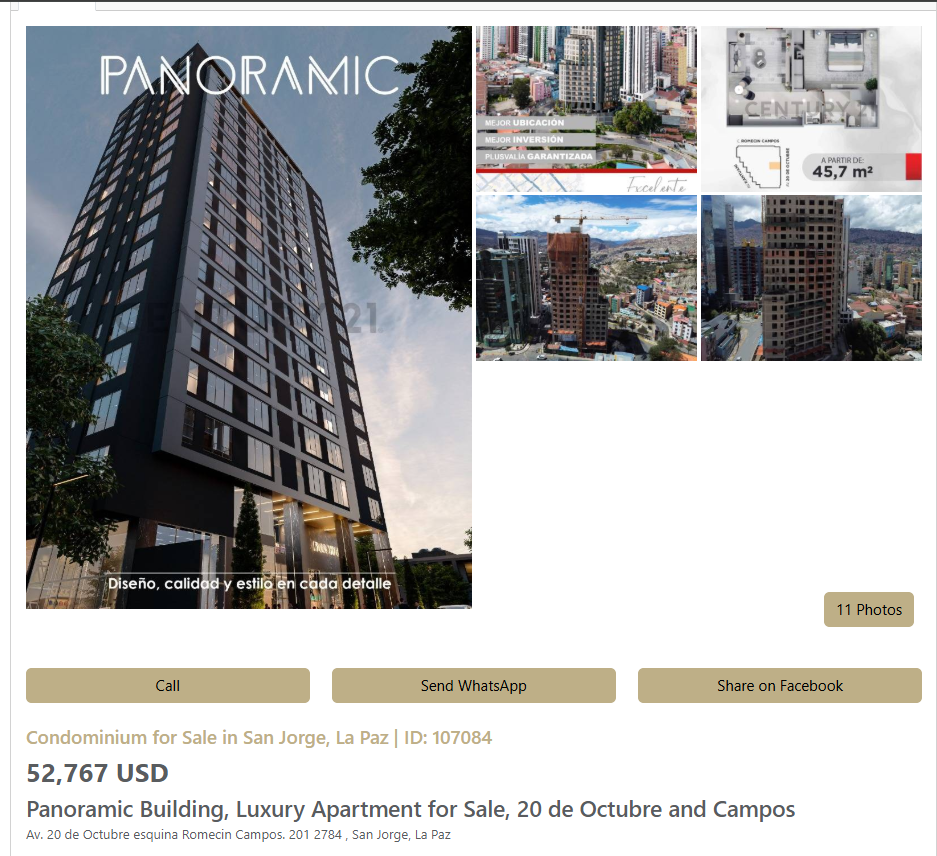
$53k USD: I found the above 1-bedroom, 1-bath apartment for sale online today in La Paz. It will likely be gone by the time you read this, but use this webpage to find what else is available that may better fit your needs.
I would not buy real estate in a foreign country until I have lived there for an extended period of time, making sure I love it after the honeymoon period. I have a report explaining what to look out for and why. But if you do decide to buy property in a foreign country, you must consult a licensed real estate attorney since the laws are not the same as in your home country.
La Paz, Bolivia, Overall Retirement Desirability Score
La Paz, Bolivia, was one of our favorite places we visited on this trip to South America. The people are very friendly, and we felt safe in the neighborhood where we stayed. Also, we were a bit surprised to find delicious 2 and 3-course lunches for under $4 USD in local-style restaurants.
This is an ancient culture that has been influenced by the world over the years, but it still has that charming historical feel with locals in traditional clothing that you see in places like Cusco, Peru. So, for people who like cooler weather and don’t mind very light snow on the ground 2 or 3 days per year, I would rate it high.
But, for someone like me, who wants to spend most of the year, day and night, in shorts, t-shirts, and flip-flops, I would rate this as a high place to visit, but only a medium place to live most of the year.
If you are really serious about retiring overseas, grab a copy of my free eBook that shares the 10 things you need to do before leaving your home country. And if you would like to know how we find great apartments all over the world, watch the video here now.
Where we stayed in La Paz, Bolivia
This Airbnb was where we stayed, and it was within walking distance of our favorite things to see and do in La Paz.
Restaurants, Services, Markets
La Paz, Bolivia, Restaurants ($1 USD is 6.9 Bs):
- El Tomate: Large magarita pizza 115 bs, Juice 30, good juice and pizza
- Restaurante Armonia: Daily menu 26bs, with juice is 30bs, free hot tea and iced tea
- Go Green: Daily menu from 27-36bs
- Flor De Loto: Daily menu 27bs
- Wistupiku: Api 8, Fresh orange juice 12, Cheese bread 11
- El Velero Ardiente Anticuchos: Grilled beef heart simple 13
- Honguito III: Grilled beef flank 28bs
- La Vieja Tienda y Café Museo: Limonae 12 bs, Affogato 20 bs
- Ciclik: Breakfast set 39bs, De Mani 42bs
- Juan Valdez – Aeropuerto El Alto HALL: Good coffee from Colombia, Coca tea 17, Agua 15, latte 34
- Altramuz: Best is chili sin carne 38
- Local lunch in El Alto: Lunch meal 20 bs
Services/Markets/Resources
- Hipermaxi Sopocachi: Neighborhood supermarket
- Fidalga Supermarket: Neighborhood supermarket
- Mercado Rodríguez: Fish from Lake Titicaca & potatoes from the Andes, sold by vendors in colorful traditional dress.
- Red cap tour: Great walking tour – 3 USD online registration
- Dr. Espada Lozada Andres: Home visit – 450 bs with medicine
- Nut store in La Paz: Walnut 1 pound =100 bs, mix nut =80 bs
- National Museum of Ethnography and Folklore: 35 bs foreigner ticket, 20 bs for camera