In this report, I share the cost to retire overseas in Chile.

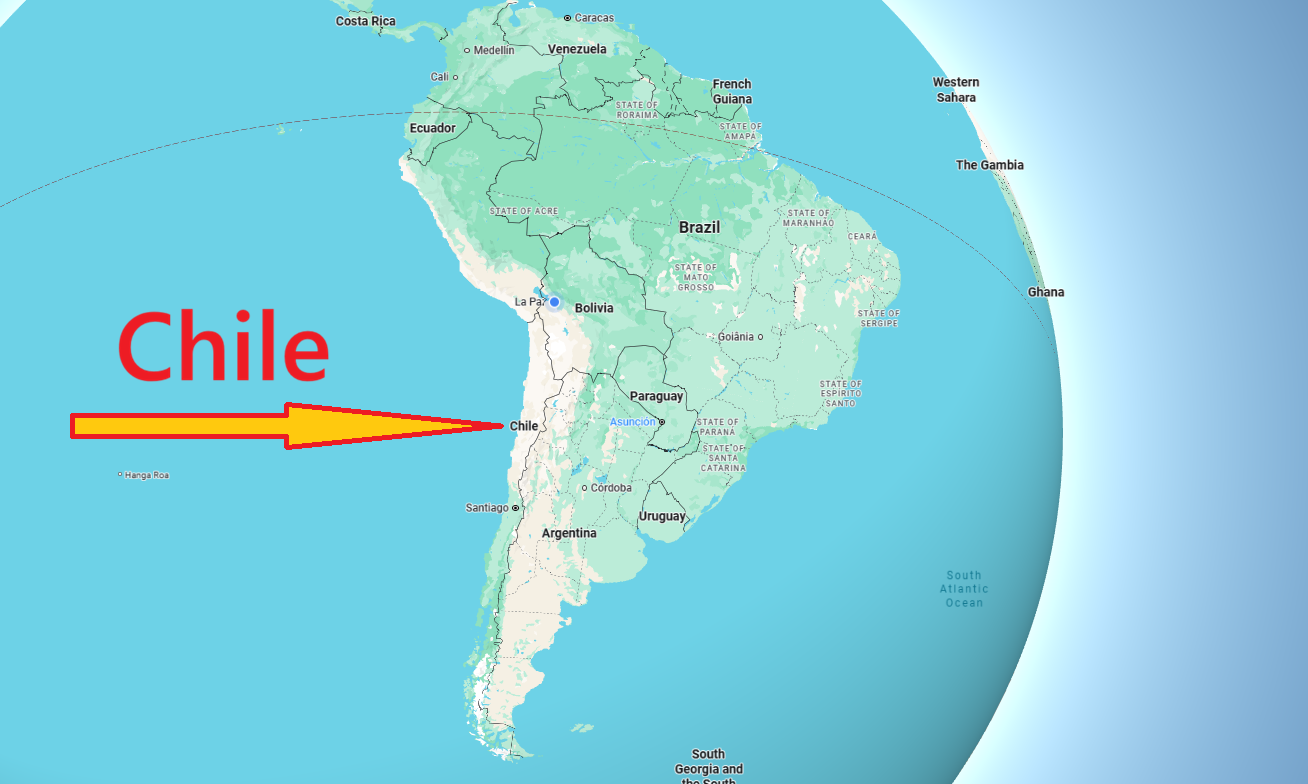
With my feet on the ground, I am going to show you living cost estimates for the low to middle range, and why many foreigners are retiring on the Ocean in Vina Del Mar, Chile
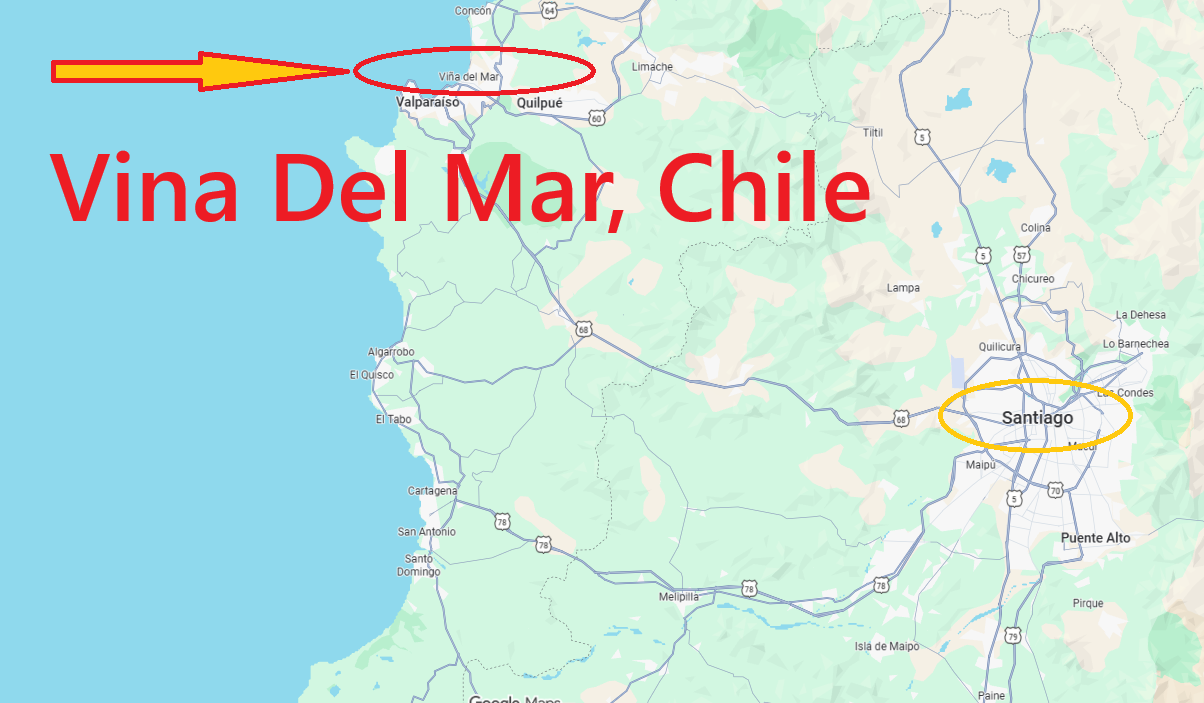

First, I will show you around Vina Del Mar, Chile, so you know whether or not you are even interested in living or retiring here. Second, I will share low to middle-range living costs. Third, I will share visas, residency, healthcare, walkability, weather, social considerations, things to do, and safety.
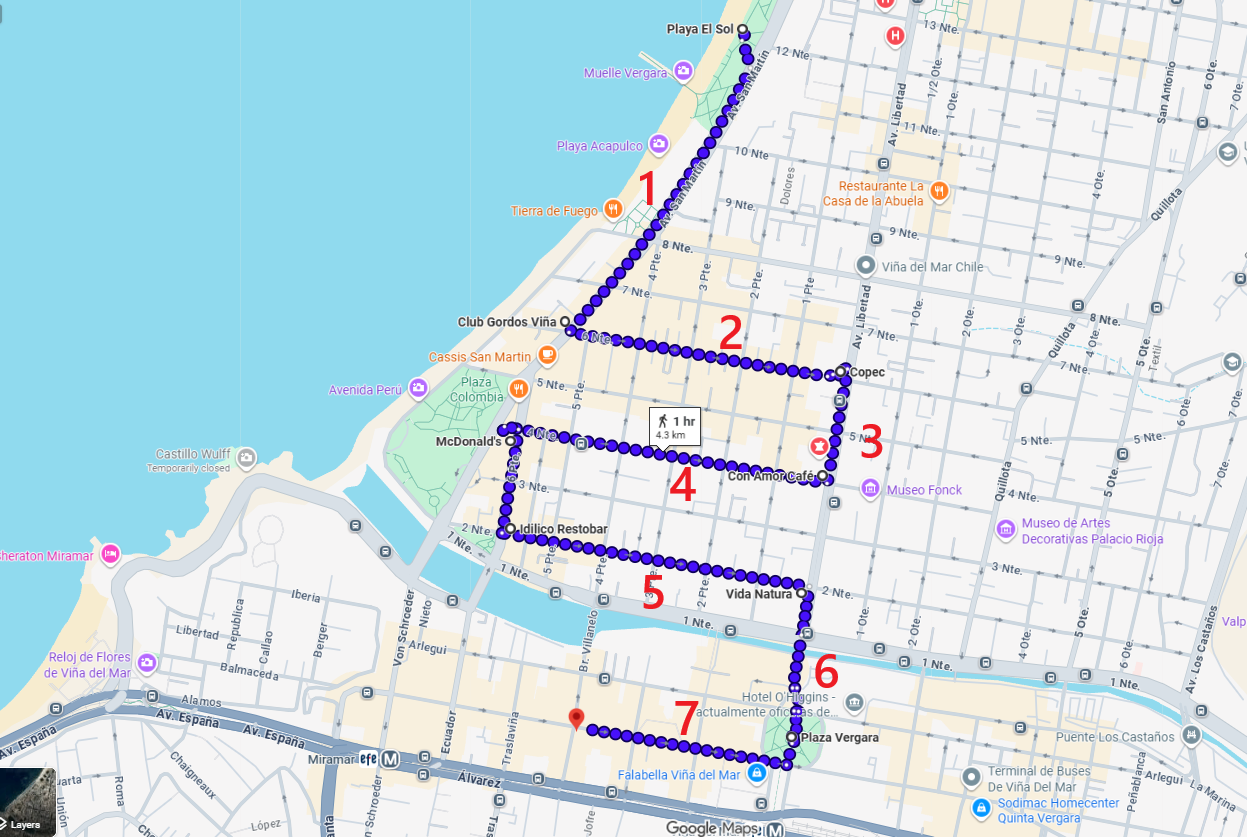
Here is a map of my favorite neighborhoods in Vina Del Mar, Chile. This walk took us a few hours, but I will just show you the highlights.
This was my first time in Chile, making it my 76th country. I left the USA in 19 years ago, traveling the world, and showing you the best places to retire affordably overseas. So subscribe to learn about my favorite countries to retire affordably overseas.
The beautiful woman you see in the videos with me is Qiang of the Hobo Ventures YouTube channel. Subscribe to Qiang’s channel if you want to see our daily lives as we move forward, slow-traveling the world on one-way tickets.
Now, I will give a line-item estimate of the cost of living for two people living long-term in Vina Del Mar, Chile. Then I will share information about retirement visas, healthcare, walkability, weather, social considerations, things to do, and safety in Chile.
Estimated Cost to Retire in Vina Del Mar, Chile

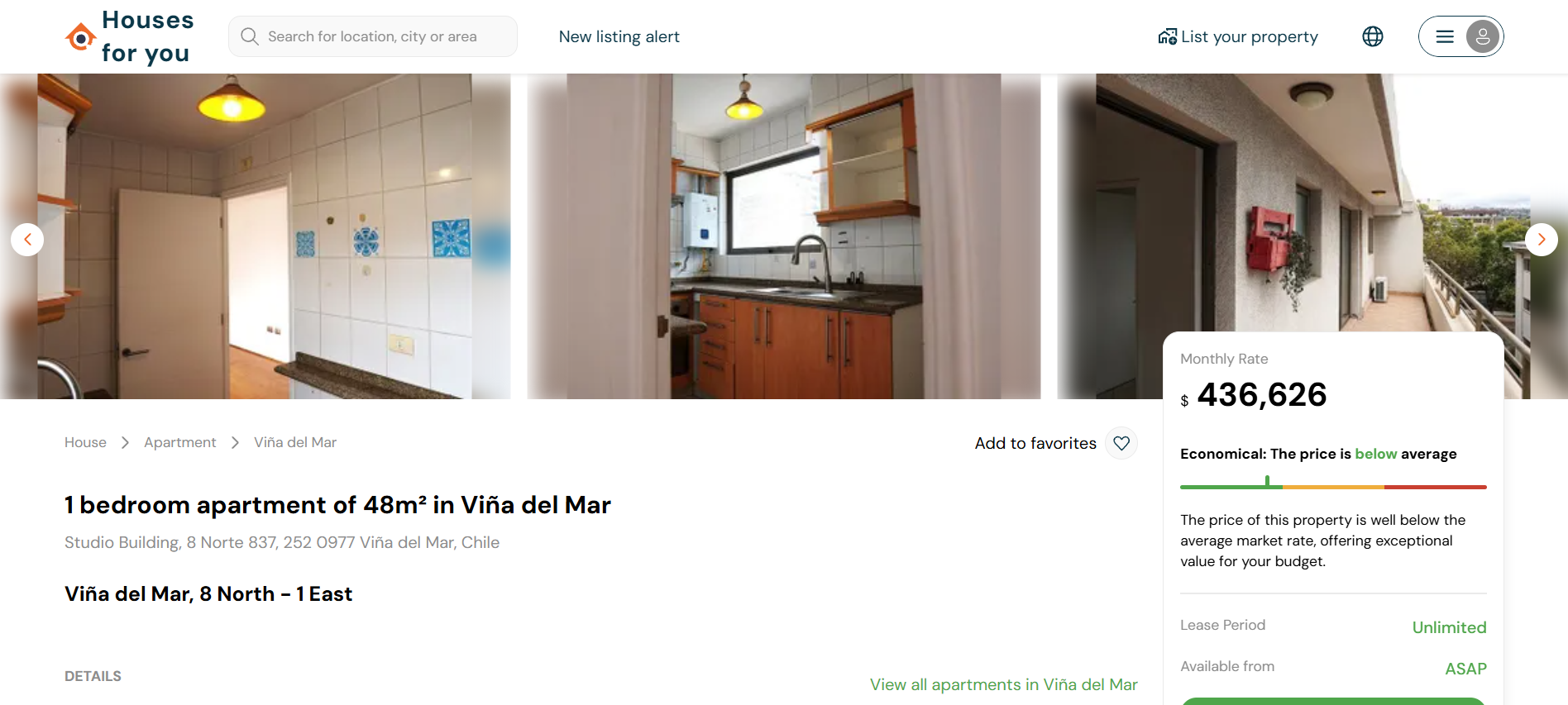
Rents: I found this 1-bedroom unfurnished apartment for rent in a nice area of Vina Del Mar, Chile. It is advertised today for 436,626 CLP, which is $504 USD per month on a 12-month lease. If you rent a furnished apartment for a shorter period on Airbnb, it would be much more expensive.
If you rent a larger apartment long-term, the rent would be higher, starting around $1000 USD per month or more, depending on the area and size.
Here is the process we use to find great apartments. So, we will show you a table of all expenses in a moment. We will use $504 USD per month for the lower rent estimate and $ 1,000 USD per month for the middle-range living cost estimate for expats who want a little more space.
Utilities: We estimate the year-round average for utilities for the smaller apartment above would be about $80.00 USD per month. The utilities would cost more for the larger space, starting at around $125 USD per month.
Groceries: We estimate about $360 per month for the two of us. Other expats are likely to purchase more imported foods from their home country, spending $490 per month on groceries.
Restaurants: We would eat out twice per week at local-style restaurants, ranging from about $7 to $9.00 USD per meal per person, and one or two splurges per month at $14 to $20 USD per meal per person. If you add it all up, we would spend around $220 per month on restaurants for the two of us. We may have a beer here and there, but that is covered below in alcohol.
Other expats are likely to eat more often at expensive restaurants and very little, if any, in local-style restaurants, so they would likely spend more like $384 per month for 2 people in restaurants. It is lifestyle-dependent.
Cell Phone Data: The cost to get a prepaid SIM card for your unlocked smartphone is about $10 USD per month.
Other expat couples are likely to buy two prepaid SIM cards so they would spend $20 USD per month or more if they get post paid service.
Laundry: Unfurnished apartments in Chile rarely come with clothes-washing machines. You can buy a new washing machine for about $500 USD, and the laundry detergent is included in the groceries bill.
Drinking Water: We bought RO drinking water from the grocery store. But if we retired here, we would buy a water filtration unit for the kitchen. A decent unit costs around $350 USD. The replacement filters are around $150 per year, so we estimate about $13 per month after we purchase the unit.
Internet: 600 Mbps in-home wifi is about $23 USD per month.
Transportation: All of our daily needs, including groceries, shopping, restaurants, coffee shops, and nightlife, would be within a 20-minute walk.
We may take an Uber home at night or to the grocery store twice a week, averaging about $4 per ride or $32 per month. We would also take public transportation (buses/trains) a few times per month to explore other parts of the city, at about $0.60 USD per person each way. So we would spend about $48.00 per month on transportation.
Other retirees may want to pay cash for a used car, but would still need to pay another $300 per month or more for gasoline, repairs, and insurance.
Alcohol (Optional): Domestic beers are about $1.20 USD in grocery stores. In bars and restaurants, domestic beers are around $3-$5 USD. So, we estimate about $120 per month for the two of us.
Many other expats would spend more on imported, craft, or foreign beers in convenience stores, bars, and restaurants, so we estimate about $230 USD per month for 2 people, assuming they do not drink imported whiskey or wine.
Entertainment (Optional): We would budget about $200 per month for the two of us. We generally enjoy doing more do-it-yourself kinds of entertainment, so other expats would spend a little more, maybe $300 per month, for 2 of them.
Basic Costs to Retire in Vina Del Mar, Chile
After the cost of living, I will share information on visas, residency, real estate, walkability, healthcare, and safety. The first link in the first comment below this video provides details on how I arrived at each line-item cost.
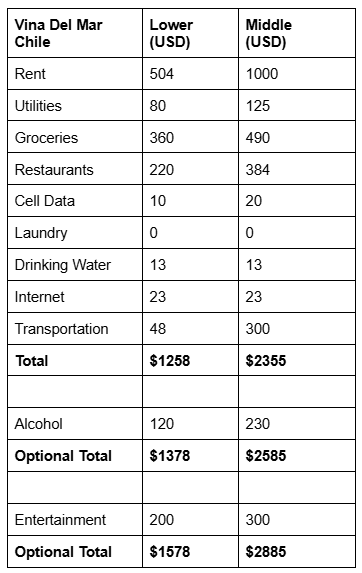
We gathered this data with our feet on the ground here in February of 2026, so adjust for inflation after that. The above lower cost-of-living estimate would apply if the two of us lived here on a tight budget. The middle estimate is just an example of what more typical expat couples might spend if they moved here.
So, what would it cost you to live in Vina Del Mar, Chile?
To understand what it would cost you to live here, you must put your feet on the ground, see how you would choose to live, eat, and entertain yourself, and add it all up. It doesn’t matter what anyone else spends because we are all different.
You should also add anything to the above table that you spend money on in your home country that is not listed in the above table. Presumably, you find those things necessary in life. To do that, visit the Numbeo Vina Del Mar and add anything not mentioned in the above table. Anything not on Numbeo you should add during your exploratory visit before moving to Vina Del Mar.
Never move anywhere until you have visited first personally to verify the living costs for your lifestyle and needs. I am not guaranteeing these prices. These are just my notes and estimates from the time of my visit and this post. Your costs will likely be drastically different depending on your lifestyle and the time since this post was published.
Typical expats’ living costs in Chile range from about $1,500 to $4,000 per month, depending on their lifestyle, budget, and whether they live in a city or a rural area.
Vina Del Mar, Chile, Livability Factors
Before you move anywhere outside your home country, make a list of the factors you must have for a happy retirement. Here are my livability factors, and I will rank each as high, medium, or low before assigning an overall retirement desirability score to Vina Del Mar.
Walkability: High. We stayed 2 blocks from the beach in Vina Del Mar. But if we retired here, we would stay about 8 to 15 blocks away from the beach for a quiter cheaper life. In that area, everything would be so centralized that we would rarely need to walk more than 20 minutes to get what we needed for everyday life. Plus, walking is the healthiest way to stay in shape as we age.
We took an Uber from the bus station to our accommodations when we arrived and when we departed. We also took an Uber to Valparaíso for a walking tour and rode the bus home afterward. Otherwise, we walked everywhere.
Internet: High. The in-home Wi-Fi in our apartment was 28 Mbps up and 36 Mbps down. Good enough for Zoom calls, uploading YouTube videos, and watching Netflix. We were also able to use our cell phones as hotspots when we were out of the house together. But 600 Mbps is available in town for $23 month if you move here.
Food: Medium. We found a couple of nice restaurants in Vina Del Mar. So we would eat out a few times a week, mostly at local-style restaurants. We would cook at home much more, though. We didn’t find any spicy dishes here, like Mexican or Asian dishes. So we would rate the food as medium. But if you enjoy more moderately spiced foods, the food would probably be rated High for you here.
Weather: High. Chile lies south of the equator, so summer runs from November through March. Summer daytime highs in Vina Del Mar average from 70 °F (21 °C) in January to 55 °F (13 °C) in July. Nightly summer lows average from 55 °F (13 °C) in January down to 43 °F (6 °C) for winter average nightly lows in July. The rainy season is May through August, with June receiving the most rain of 4.6 inches (118 mm).
Things to Do: High. Viña del Mar (or Vina) is known as the “Garden City” and is well known in Chile as one of the nicest beach holidays. Viña del Mar hosts the International Song Festival in Quinta Vergara, one of Latin America’s largest music events.
Vina is just 20 minutes north of the most colorful city in Chile, called Valparaíso. We did a safe 3-hour group day tour of Valparaíso with Tour for Tips, and loved it. I do not recommend visiting Valparaíso without a guided group. Vina Del Mar felt much safer to us.
Viña really has two different personalities, which I label as North Vina and South Vina, as shown in the following map.
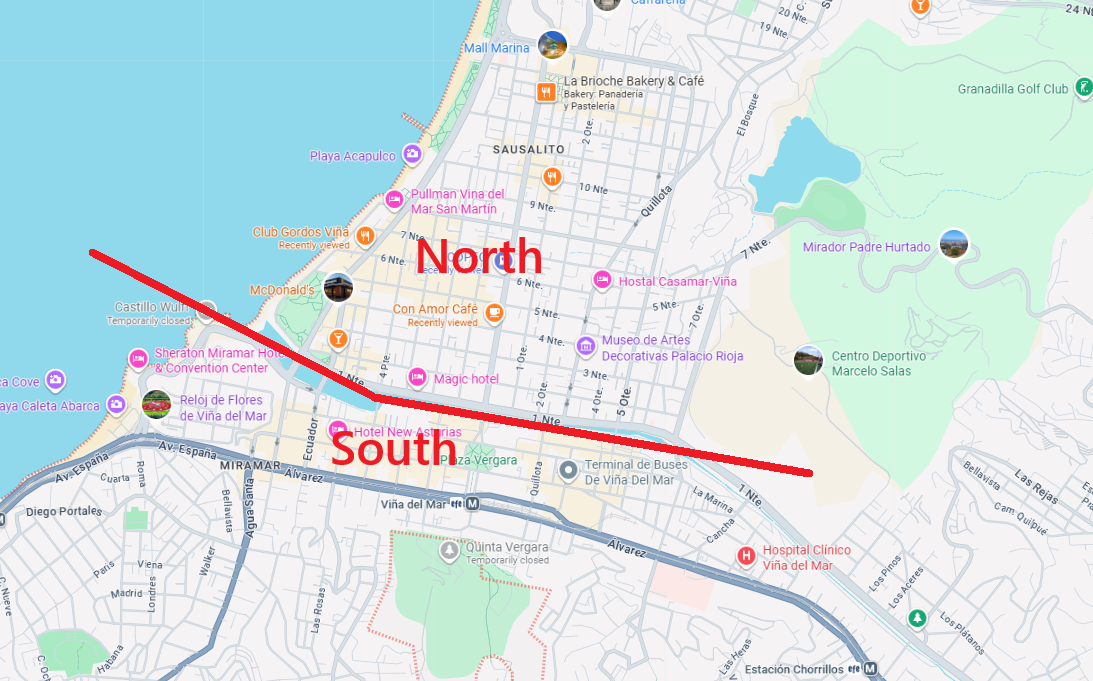
 North Vina is more upscale and expensive than South Vina. If you haven’t spent much time in Latin America, you may be more comfortable in the North. It generally feels safer in the North, but if you spent a lot of time in Latin America, the North may feel a little antiseptic to you.
The South is generally cheaper and provides a more local and gritty feel to it, but can also be more fun if you have your Latin legs under you. You can get a traditional Chilean lunch in the South for $5 to $9 USD, but meals seem to be $9 or more in the North.
If you are not sure where you will feel more comfortable, I would suggest staying in the North and then wandering down into the South during the day and exploring.
In general, if you are looking for a beach vacation, you will find pretty much everything you will need in Vina, including a fun beach scene, some nice restaurants, and nightlife that varies greatly from high to low season. The high season is summer, from December to February. It is more expensive in high season.
Social Considerations: Medium. English is not widely spoken in Chile. But you will hear a little more English spoken in tourist-facing businesses in Vina. If you intend to retire here, you should learn Spanish for a fuller life. I have met many expats overseas who have used Duolingo, the free language-learning smartphone app, to learn various languages. If you are just visiting, become familiar with using Google Translate on your smartphone before you arrive.
Safety: Medium. The neighborhoods on my walking map above felt safe during the day, but do your best not to get isolated at night. In the South area of Vina, there is slightly more crime, especially at night. But don’t get isolated in the South, even in the day.
Use Uber taxi to get home at night, and nothing valuable should be in an unsecured pocket or backpack; don’t leave valuables out in the open. Also, the US State Department issues travel advisories for each part of the world, which you should be aware of. Read that before you go, and thereafter from time to time to stay up to date. Chile, at the time of this writing, is “Level 2: Use Increased Caution.” Here are my thoughts on how to remain safe all over the world.
Expat Community: Medium. Here are some Facebook groups 1, and 2 that cater to English-speaking expats living in Chile. These online expat communities are great for learning what expats want to know when they first move overseas. You will often find that someone has recently answered your questions, so first search for already answered questions before asking in these groups.
Medical: High. This healthcare international comparison index ranks Chile 51st in the world, 18 places better than the United States, which ranks 69th. There are different ways healthcare is rated, but this one seems to be considering not only the quality of care but also what patients are charged.
All retired permanent residents of Chile are entitled to enroll in FONASA, which includes hospitals and clinics. To enrol, you must contribute 7% of your monthly pension/income. It covers basic medical care, hospitalizations, emergency services, and medications, but you may experience longer wait times for non-emergency procedures. There is also private insurance if you prefer.
Tourist Visa: High. Citizens of the US, UK, Canada, and the EU, as well as many other Western nations, do not need a visa for 90-day tourist visits. You must present a valid passport (valid for at least 6 months), and they might ask for proof of onward/return travel and accommodations. Upon entry, you will be issued a tourist card that you will need when you exit. You can also apply for a 90-day extension. When I flew into Chile only asked for my passport and the purpose of my visit, nothing else.
These conditions change periodically, and sometimes airlines will ask for information that immigration doesn’t check, so check both before you attempt to enter.
Retirement Visa: Americans must show a stable, recurring monthly income of approximately $1,500 USD from pensions, Social Security, or investments. You need a valid passport, an FBI background check, a medical certificate, and private insurance in Chile, and other documents depending on circumstances, and all documents must be apostilled and translated into Spanish. After 24 months of continuous residence, you can apply for permanent residence.
It is highly recommended that you use a licensed immigration lawyer in Chile to help you through this process. Contact the lawyer before you arrive because laws change, so the documents you need may change at the time you intend to apply.
I would request a referral to a lawyer on one of the Expat Facebook pages I shared above. I would ask the expats for an immigration lawyer whom they used personally to get their residency.
Real Estate: In general, foreigners can own land in Chile in their own name at this time with minimal restrictions. 
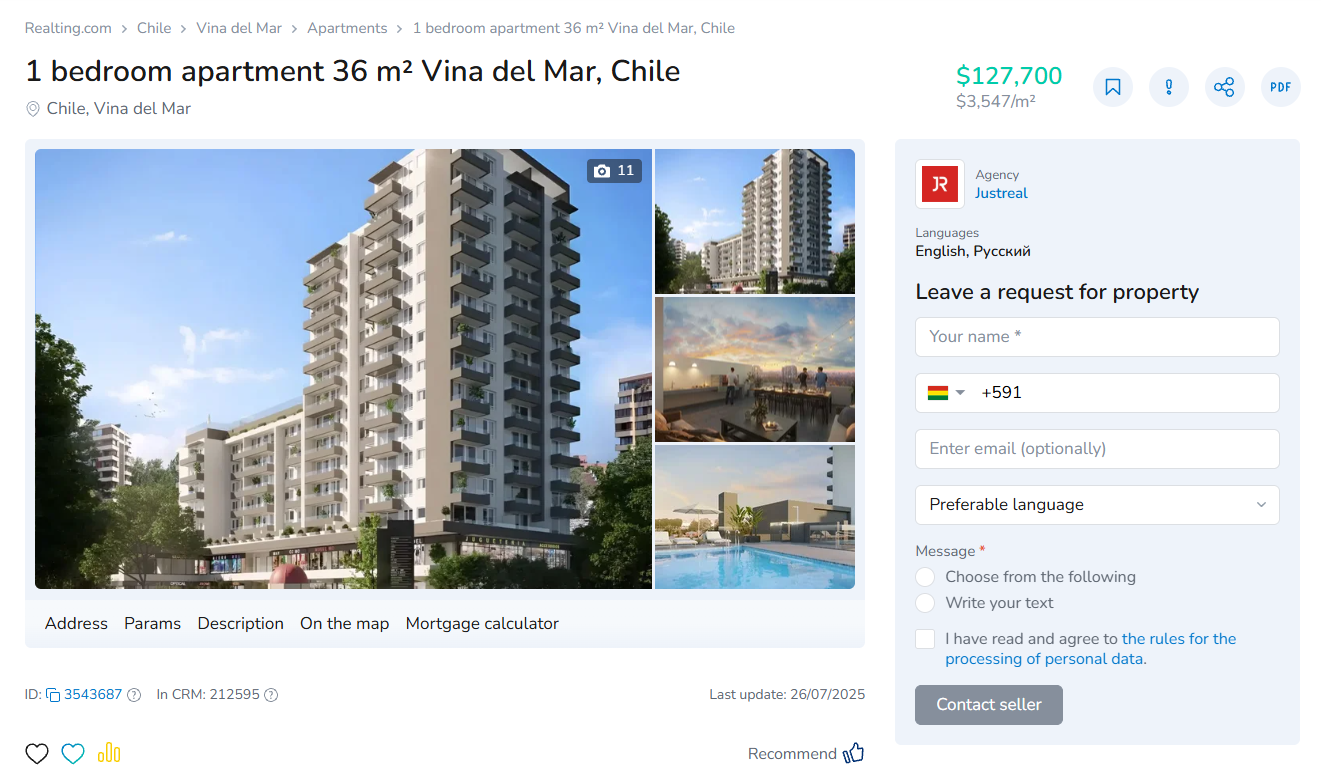
$128k USD: I found this apartment for sale online today in Vina Del Mar. It will likely be gone by the time you read this, but use this webpage to find what else is available that may better fit your needs.
I would not buy real estate in a foreign country until I have lived there for an extended period of time, making sure I love it after the honeymoon period. I have a report explaining what to look out for and why.
Vina Del Mar, Chile, Overall Retirement Desirability Score: High.
I would give Vina Del Mar, Chile, a High overall retirement desirability score mainly because it seems like a laid-back, chill lifestyle that reminds me of the West Coast of the USA. You have a beautiful coastal range of smaller mountains between you and a fertile valley, you are near wine country, there is a laid-back feel at the beach, and you are only about 1.5 hours from the capital, Santiago, by bus for about $10 USD, where you have all the amenities of a big city. Ultimately, that high ranking depends on whether you love the life available within your budget, which you will only truly know when you put your feet on the ground here and take an exploratory visit.
Where we stayed in Vina Del Mar, Chile
This Airbnb is where we stayed, but we would stay farther from the beach next time. There was a restaurant across the street that played loud music at night.
Restaurants, Services, Markets
Vina Del Mar: Restaurants ($1 USD is 868 CPL):
- Corazón Contento Brunch: 3-course meal 7900 CPL kish tart, Menu 2 8500 CPL with beef stew
- McDonald’s: Breakfast egg muffin with bacon, avocado egg + coffee 2890 CPL
- San Romano Pizzeria: Margherita pizza 13000 CPL, 2 pint beer 7500 CPL
- Vegan Place: XL hotdog bread 7300 CPL, Green bowl 8990 CPL (Best meal in Vina)
- CAFÉ AUSTRAL: Cappuccino 2890 CPL, Cheese cake 5390 CPL
- Burger King: Vege burger 7300 CPL, Whopper beef 7300 CPL
- Bar Kabala: Happy hour (2 for 1) Mojitos 7700 CPL
Services/Markets/Resources
- Movistar Sim: Buying in airport convenience store, 4990 CPL for 40 GB/ 500 minutes/30-day
- Terminal de Buses Pajaritos: Bus from Santiago to Vina, FLIX bus – Bus ticket 7179 CPL
- Banco de Chile: ATMs used
- Unimarc: Supermarket and ATM we used
- Tour for Tips: We went on the Street Art tour of Valparaíso. Just tip at the end. We took a bus to and from Valparaíso for 500 CPL per person each way.