Why do some expats intentionally live in larger cities? You may prefer a smaller city. But sometimes change surprises us, and we end up liking something new. Check this out.
Intentional living is the idea of choosing a place that aligns with your core values and desired lifestyle. What values and lifestyles are supported in a limited number of larger cities?
One such value is to live a simple, neighborhood life while still maintaining access to world-class dining, live music and entertainment, and diverse cultural festivals.
Some Expats live a hyper-local life, meaning a 15-minute walk to everyday needs like groceries, restaurants, gyms, coffee shops, parks, and casual nightlife. The right neighborhood in a larger city allows them to give up the car and walk everywhere.
And, walking is healthy.
A hyper-local life creates the intimacy of a neighborhood. Such a hyper-local life can be found in well-managed small towns, but in others, everyday needs are too spread out to walk to.
But even in the rare completely walkable small town, some people get bored.
Yet, some large cities have great public transportation. This allows people to step out of their hyper-local life and experience the energy and excitement of their surrounding urban environment, including the arts, cultural events, and live entertainment.
São Paulo is one of many large cities around the world that offer hyper-local neighborhoods with great city-wide public transportation. But unlike other cities like Tokyo, New York, Paris, London, or Berlin, you may find Sao Paulo affordable.
After sharing living costs in São Paulo, Brazil, I will explain the 8 factors I use to identify whether a location is desirable as a retirement destination.
But why should you listen to me? I left the United States in 2007. I’ve lived in 75 countries over the last 19 years. I buy one-way tickets and travel the world while sharing the best places to retire affordably overseas.
Subscribe if you want to know the best places to retire overseas. Visit my country playlists on YouTube to learn about my favorite places to retire affordably overseas. Okay, let’s talk affordability in São Paulo Brrazil.
Estimated Cost to Retire in São Paulo, Brazil
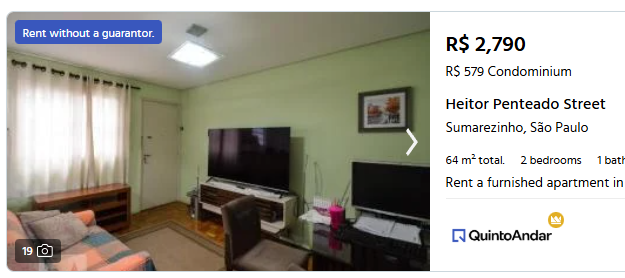
Rents: I found a furnished 2-bedroom apartment advertised for rent today for R3369 ($637 USD) per month, with a long-term lease agreement in one of our favorite parts of São Paulo. If you rent for a shorter period on Airbnb, it would be much more expensive.
If you rent a larger apartment long-term, the rent would be higher, starting around $1050 USD per month or more, depending on the area and size.
Here is the process we use to find great apartments. So, we will show you a table of all expenses in a moment. We will use $637 USD per month for our lower rent estimate and $1050 USD per month for the middle cost-of-living estimate for expats who want a little more space.
Utilities: We estimate the year-round average for utilities for the smaller apartment above would be about $80 USD per month. The utilities would cost more for the larger space, starting at around $130 USD per month.
Groceries: We estimate about $350 per month. Other expats are likely to shop more often in expensive grocery stores, often spending more than $425 per month on groceries.
Restaurants: We would eat out twice per week at local-style restaurants for about $7 to $ 10 USD per meal per person, and one or two splurges per month of $12 to $22 USD per meal per person. If you add it all up, we would spend around $210 per month on restaurants for the two of us. We may have a beer here and there, but that is covered below in alcohol.
Other expats are likely to eat more often at expensive restaurants and less often at local-style restaurants, so they would likely spend more, like $350 per month for 2 people. It is lifestyle-dependent.
Cell Phone Data: The cost to get a prepaid SIM card for your unlocked smartphone is about $10 USD per month.
Other expat couples are likely to buy two prepaid SIM cards so they would spend $20 USD per month.
Laundry: Unfurnished apartments in São Paulo generally have no washing machines. Drop off laundry in the area would charge us about $12 USD for 5 kg of laundry per week, or $48 USD per month.
Drinking Water: Ceramic drinking water filters in Brazil typically cost around $120, and the filters require replacement every year at approximately $100. So we would spend about $12 per month on drinking water.
Internet: 60 Mbps in-home wifi is about $20 USD per month.
Transportation: We loved the Vila Madalena area of São Paulo. All of our daily needs, including groceries, shopping, restaurants, coffee shops, and nightlife, would be within a 20-minute walk. We may take an Uber home at night or to the grocery store twice a week for about $2 to $4 per ride, or $16 per month. We would also take public transportation (buses and the subway) a few times per month to explore other parts of the city, at about $1 USD per person each way. So we would spend about $30 per month in transportation.
Other retirees may want to pay cash for a used car, but would still need to pay another $260 per month or more for gasoline, repairs, and insurance.
Alcohol (Optional): Domestic beer in grocery stores in São Paulo is $0.80 USD. In bars and restaurants, domestic beers are around $2-$5 USD. So, we estimate about $110 per month on alcohol for the two of us.
Many other expats would spend more on imported foreign or craft beers in convenience stores, bars, and restaurants, so we estimate about $300 USD per month for 2 people, assuming they do not drink imported whiskey or wine.
Entertainment (Optional): We would budget about $200 per month for the two of us. We generally enjoy doing more do-it-yourself kinds of entertainment, so other expats would spend a little more, maybe $300 per month, for 2 of them?
Estimated Costs Retire in São Paulo
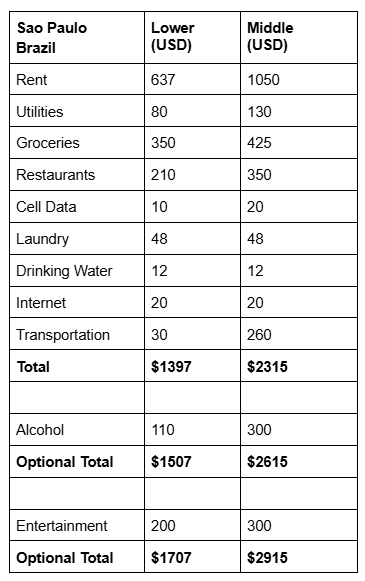
We gathered this data on the ground here in December of 2025, so adjust for inflation after that. The above lower cost-of-living estimate would apply if the two of us lived in São Paulo on a tight budget. The middle estimate is just an example of what more typical expats might spend if they moved here.
So, what would it cost you to live in São Paulo, Brazil?
To understand what it would cost you to live here, you must put your feet on the ground, see how you would choose to live, eat, and entertain yourself, and add it all up. It doesn’t matter what anyone else spends because we are all different.
You should also add anything to the above table that you spend money on in your home country that is not listed in the above table. Presumably, you find those things necessary in life. To do that, visit the Numbeo Sao Paulo and add anything not mentioned in the above table. Anything not on Numbeo you should add during your exploratory visit before moving to Sao Paulo.
Never move anywhere until you have visited first personally to verify the living costs for your lifestyle and needs. I am not guaranteeing these prices. These are just my notes and estimates from the time of my visit and this post. Your costs will likely be drastically different depending on your lifestyle and the time since this post.
Typical expats’ living costs in São Paulo, Brazil, range from about $1800 to $4500 per month. But people spending that much often have higher savings, incomes, or pensions. They often report spending more on accommodations, entertainment, eating out more, traveling, and alcohol. Many also have more expensive cars, houses, or apartments.
São Paulo, Brazil, Livability Factors
Before you move anywhere outside your home country, make a list of things you must have for a happy retirement. Here are my livability factors, and I will rank each as high, medium, or low before assigning an overall retirement desirability score.
Walkability: High. We could walk everywhere in our favorite neighborhood in São Paulo. Everything was so centralized that we rarely needed to walk more than 20 minutes to get where we needed to go for everyday purposes. Plus, walking is the healthiest way to stay in shape as we age. We would hop on the bus or subway to get to other parts of the city.
Internet: High. The in-home wifi in our apartment was 60 MBPS up and down. Good enough for Zoom calls, uploading YouTube videos, and watching Netflix. We were also able to use our cell phones as hotspots when we were out of the house together.
Food: Medium. São Paulo has some amazing international restaurants, but they are spread all over the city, so they wouldn’t be convenient to frequent. Brazilian restaurants are in every neighborhood and are quite good overall. So, for most people, I would rate the food as high. But, we love more spicy food. So, if we lived here, we would tend to cook at home because we miss spicy dishes like Mexican, Asian, and other spicy International favorites. So we would rate the food as medium.
Weather: High. Brazil is below the equator, so summer starts in December. Summer daytime highs in São Paulo range from 84 °F (29 °C) in February to 73 °F (23 °C) in July. Nightly summer lows average from 69 °F (21 °C) in February down to 56 °F (13 °C) for nightly winter lows in July. The rainy season is December through March, with January receiving the most rain of 9.7 inches (246mm).
Things to Do: High. São Paulo has a successful symphony, theatre, and opera scene, with several major venues and local organizations dedicated to these art forms. São Paulo also has everything you would expect from a vibrant, energetic city of this size, including culinary arts, live music, jazz festivals, and other cultural events. It is also just about 80 minutes from one of our favorite beach cities in Brazil, called Santos. The bus to the beach is just $10 USD. There is also great nightlife in the city and modern malls with the best products from around the world.
Social Considerations: Medium. English is not widely spoken in Brazil, but there are slightly more English speakers in São Paulo than in smaller towns. You will find some English speakers in tourist-facing businesses, but you can’t depend on it. So, if you intend on retiring here, you should learn some Portuguese for a fuller life. I have met many expats overseas who have used Duolingo, the free language-learning smartphone app, to learn various languages. If you are just visiting, become familiar with Google Translate before you arrive.
Safety: Medium. São Paulo is the second safest state in Brazil. São Paulo felt safer to us than Rio, and that is confirmed statistically. But you need to remain aware of your surroundings when in Brazil and do your best not to get isolated, especially at night.
Use Uber taxi to get home in the evenings. Nothing valuable should be in an unsecured pocket or backpack, and don’t leave valuables out in the open. Also, the US State Department issues travel advisories for each part of the world, which you should be aware of. Brazil is level 2 right now, “Exercise Increased Caution.” We often travel to level 2 locations, so this was not a big concern for us, but you should be aware of it nevertheless. Here are my thoughts on how to remain safe all over the world.
Expat Community: Medium. Here are a few Facebook pages 1, 2, and 3, that cater explicitly to English-speaking expats living in teh State of São Paulo. These online expat communities are great for learning things that expats want to learn when they first move overseas. You will often find that someone has answered your questions recently, so first search for already answered questions before asking questions in these groups.
Medical: High. This healthcare international comparison index ranks Brazil 83rd in the world, which is not quite as good as the United States, which ranks 69th in the World. There are different ways healthcare is rated, but this one seems to be considering not only the quality of care but also what patients are charged.
The good news is that Brazil’s public healthcare system is free for all citizens and visitors, as mandated by the country’s constitution. Several tourist videos report receiving free treatment in hospitals in Brazil.
Tourist Visa: High. Australia, Canada, and the United States are countries whose citizens are currently required to get a digital e-Visa for tourism and business travel to Brazil for 90 days. Other countries should check the embassy in their home country to verify entry conditions, or consult the bottom of this page.
Retirement Visa: You must demonstrate a $ 2,000 USD per month pension or equivalent, prove you are retired in your home country, provide a clean criminal record in your home country, and prove you have health insurance if the application is made from outside Brazil. Details.
You can probably do this yourself, but if you want a lawyer, I would request a referral on one of the Expat Facebook pages I shared above. I would ask the expats for the immigration lawyer they used personally to obtain their retirement visa.
Real Estate: Foreigners can own land in Brazil, although there are some limitations and significant complications even for Brazilians.
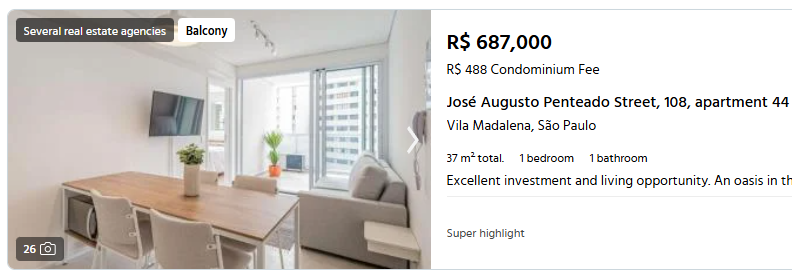
Great Neighborhood $130k USD: I found this online for sale today. It will likely be gone when you read this, but use this webpage and search in São Paulo in the Vila Madalena area if you are interested.
I would not buy real estate in a foreign country until I have lived there for an extended period, making sure I love it after the honeymoon period. I have a report explaining what to look out for and why. I would also hire a lawyer who has no conflict of interest with me. Do not use a lawyer recommended by your real estate broker or your local lover. I would seek a referral from an expat who has used that lawyer’s services to successfully buy real estate in Brazil.
São Paulo, Brazil Overall Retirement Desirability Score: Medium. For most people retiring overseas, they’re probably going to prefer a slower pace. But for expats that want to live hyper local in a walkable area but sill have access to all the amenities of a larger city, I would say it is highly desirable.
São Paulo Old Town Walking Tour
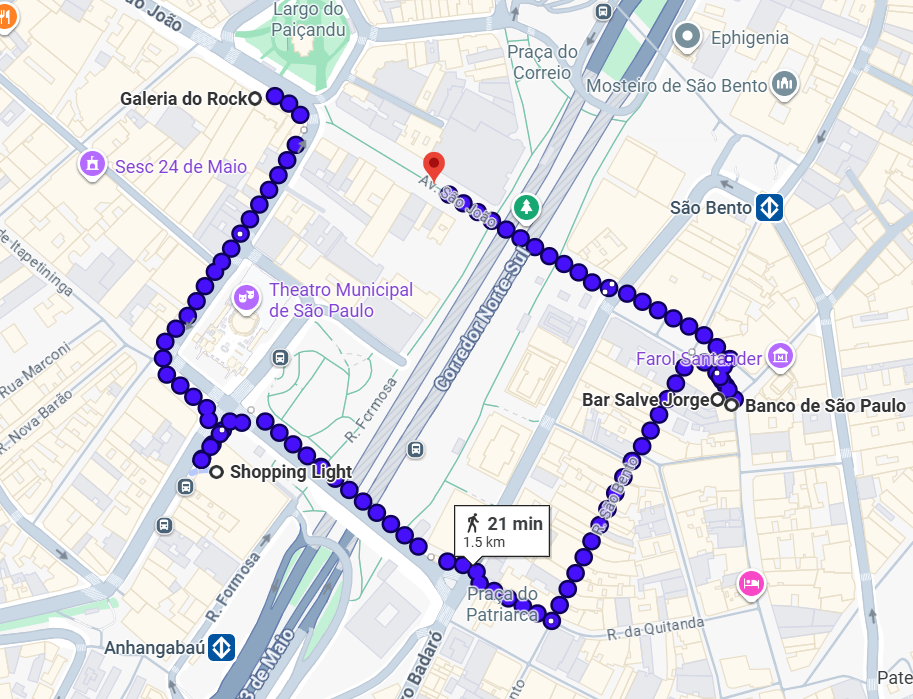
This Google Map is a nice daytime way to walk around old town São Paulo on a nice day.
Galeria do Rock: This is a multi-story mall with mostly old rock and roll memorabilia. It sounds funny, but it’s quite nice.
Shopping Light: This is a shopping mall. But find the old elevator and ride it to the top and have a beer at the rooftop bar.
Banco de São Paulo: This building is an architectural treat. Notice the other beautiful buildings nearby, also.
Bar Salve Jorge: Go upstairs and have a late lunch while you enjoy one of the most fascinating daytime live music venues in the world. Look closely at all the famous people from around the world who have been here before you.
Calçadão da Avenida São João: A pedestrian walk that is full of people watching.
Favorite Neighborhood
I would walk this neighborhood over several weeks to find the perfect spot where I wasnear shopping, coffee shops, grocery stores, and a casual nightlife. It seems to have the right mix of walkable life that is relatively affordable and close enough to public transportation to get to other parts of the city when the mood strikes. Google Map.
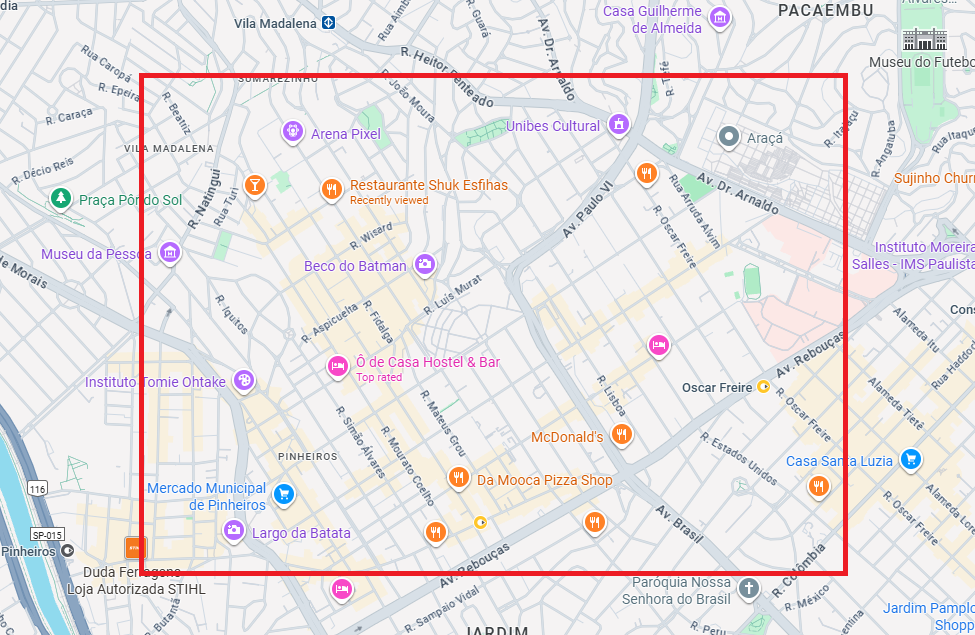
Where we stayed in São Paulo
This was my first time on the ground in São Paulo, and we were really happy with the Airbnb we stayed at. Next time, I will try to get a little closer to my favorite area above so I can look there.
How we got to Sao Paulo, Brazil
We took an Uber from our Airbnb in Guarujá to our Airbnb in São Paulo. It was 1.5 hours and cost about $48 USD.
Restaurants, Services, Markets
Restaurants, Bars ($1 USD is R5.34 Brazilian real (R)):
- Pop Vegan: Great-All you can eat R20 weekday / R23 weekend
- Lotus Vegetarian Chinese Restaurant: Chinese vegetarian 70R/kg
- Restaurante Shuk Esfihas: Beef kebab R32, Hummus R38, Salad Dakos R45, pita bread R6
- Vita Natural: Healthy Buffet.
- Subte Vegan: Matcha latte R17
- Madeleine Jazz Bistrô: Red label 2 shot R50, Beef R17, live jazz ticket R55
- GUA.CO – Pinheiros: Mexican food – Chicken bowl R45, Vegan chili bowl R48
- Terraço Notiê by Priceless: Draft beer R14
- Bar Salve Jorge: Spaten 600ml R23, Beef fillet with basil Rivoli R85, Live music fee R15
- Terraço Notiê by Priceless: Rooftop bar draft beer R14
Services/Markets/Interesting things to see:
- Metropolitan Cathedral: Beautiful
- Beco do Batman: Colorful street art
- Supermarket Mambo: No need membership for discount
- JIA HE supermarket: Best Chinese/Asian market – with tofu
- Korean Mart: Ice cream
- TOWA: Asian supermarket
- Brigadeiro – subway station: Best subway stop for Sunday Car Free Street in Anenida Paulista